
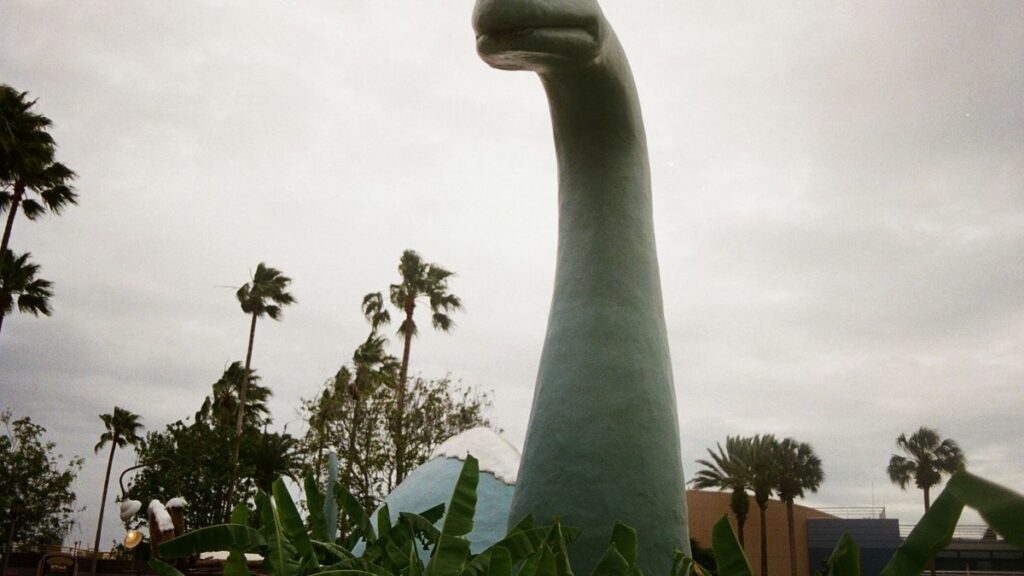
The received wisdom about Jurassic Park is that it is a special effects milestone with a thin story attached, a film we admire for its technology and forgive for its screenplay. Half of that is true. The half that is wrong is the important half, because the technology in this film is not the achievement. The achievement is that Steven Spielberg understood, better than anyone working before or since, that a computer-generated animal is only convincing if you are looking at something else when it arrives.
The Withholding
Count how long the film makes you wait. The opening sequence shows you almost nothing: a crate, a light, a handler’s face, a hand, and a great deal of screaming. Later, an investigator holds a fossil while an unseen presence is discussed entirely in terms of its effects. The first full reveal, when it comes, is not a predator at all but a plant eater, and Spielberg stages it in daylight, wide, with the camera tilting up and the actors’ faces doing most of the work.
This is exactly the strategy of Jaws, transplanted from a mechanical shark that would not function to digital creatures that functioned beautifully. Spielberg withheld anyway. It is the single best decision in the picture, and its consequences are visible today: the effects in Jurassic Park have aged well not because the rendering was ahead of its time (it was) but because the film shows you the animals in the conditions where any image looks real, which is to say briefly, partially, in bad weather, at night, in the rain, through glass, and always with a human face in frame to tell you how to feel about it.
The famous shot of vibration rings in a glass of water is the whole method in miniature. The audience is being trained to read an absence. By the time the animal arrives, we have already imagined something worse, and the film only has to confirm it. Add Stan Winston’s animatronics for the close work, and Gary Rydstrom’s sound design, which builds the creatures out of noises no reptile ever made, and you have a set of illusions that hold up because they were never asked to do more than they could.
The Craft in the Middle
The film’s central act, the one everyone remembers, is a masterclass in geography and escalation that deserves more credit than the effects usually leave room for. Spielberg builds each sequence around a specific, easily grasped physical problem. A vehicle is in the wrong place. A fence has no power. A child is in a tree. A door will not lock. Each problem is stated in visual terms, and each solution creates a worse problem in a space we have already been shown.
The kitchen sequence in particular is close to perfect suspense construction, and it is worth noticing that it contains no music for long stretches, almost no dialogue, and only one idea: two children and two animals in a room full of reflective surfaces. Spielberg lets the audience do the arithmetic. The scene works on people who have seen it thirty times, which is the real test.
John Williams’ score is doing something subtler than its reputation suggests. The main theme is not adventure music, it is hymnal, closer to awe than excitement, and it is deployed almost exclusively in the film’s first half, where the subject is wonder. As the picture turns, the theme largely withdraws, and what replaces it is percussion and silence. The score is a map of the film’s argument.
What the Film Thinks It Is About
Here is the reservation, and it is a real one: Jurassic Park has a serious idea and refuses to dramatize it.
The idea is stated outright at a lunch table roughly a third of the way in, when Jeff Goldblum’s mathematician tells the park’s founder that his scientists were so preoccupied with whether they could that they never stopped to ask whether they should. It is a good line, delivered by the film’s most enjoyable performance, and it is also the moment the film hands you its thesis on a card instead of putting it into events. That entire scene is people sitting in chairs explaining the movie’s morality to each other. It stops the picture dead, and everything it says would have been more powerful if the film had trusted us to derive it.
The film’s treatment of Richard Attenborough’s Hammond is where this really costs it. In Michael Crichton’s novel he is a genuinely dangerous figure, a man whose charm is a business instrument and whose negligence is culpable. Spielberg softens him into a benign grandfather with a flawed dream, and the film keeps finding ways to let him off: he is sentimental about his flea circus, he is wounded when criticized, he shares ice cream. The result is that a story about corporate hubris has no one at the top who is actually responsible for anything. Blame gets displaced onto a sweaty, greedy programmer and an absent legal team, which is a much smaller and much safer target. The film wants to be a cautionary tale about people who build things they cannot control, and it flinches from the one character who built it.
The humans generally are functional rather than alive. Sam Neill and Laura Dern are both very good at the specific job of reacting credibly to nothing, and Dern in particular gets the film’s best non-verbal work, but the characters are assembled from parts. Neill’s paleontologist is given a dislike of children in the first ten minutes for the sole purpose of losing it later, and the arc is executed so mechanically that you can see the beats coming from the moment the trait is announced. The children are written as functions, one to be capable at a keyboard, one to be small and endangered. Only Goldblum is allowed to be a person rather than a role, and he mostly achieves it by ignoring the rhythm of his own dialogue.
There is one more complaint, which we will keep vague. The final sequence resolves its situation with an arrival that does not survive any thought about the layout of the building we have just spent twenty minutes learning. It is a thrilling piece of staging and a cheat, and it is a cheat in a film that had, until that point, been unusually disciplined about its own rules.
Why It Lasts
None of that has dented it, and the reason is worth being honest about. Jurassic Park is not durable because of its argument. It is durable because it contains, in its first hour, one of the few sustained depictions of wonder in modern popular cinema that does not feel manufactured. The moment a scientist takes off his sunglasses and physically has to be pushed toward what he is seeing is a piece of direction about looking, and about how rare it is for anyone to see something genuinely new.
Spielberg is often accused of sentimentality, and often fairly. But the awe in this film is not sentimental, it is closer to vertigo, and the second half of the picture is an argument that the awe was always going to cost something. That the argument is delivered in dialogue rather than earned in structure is a real failing. That the awe itself is completely convincing is why the film outlived its own sequels, its own effects revolution, and most of the blockbusters that studied it.
Watch it for the first hour, which is about seeing. Stay for the second, which is very well made suspense with a moral it keeps announcing. It is not a perfect film. It is an essential one.
