
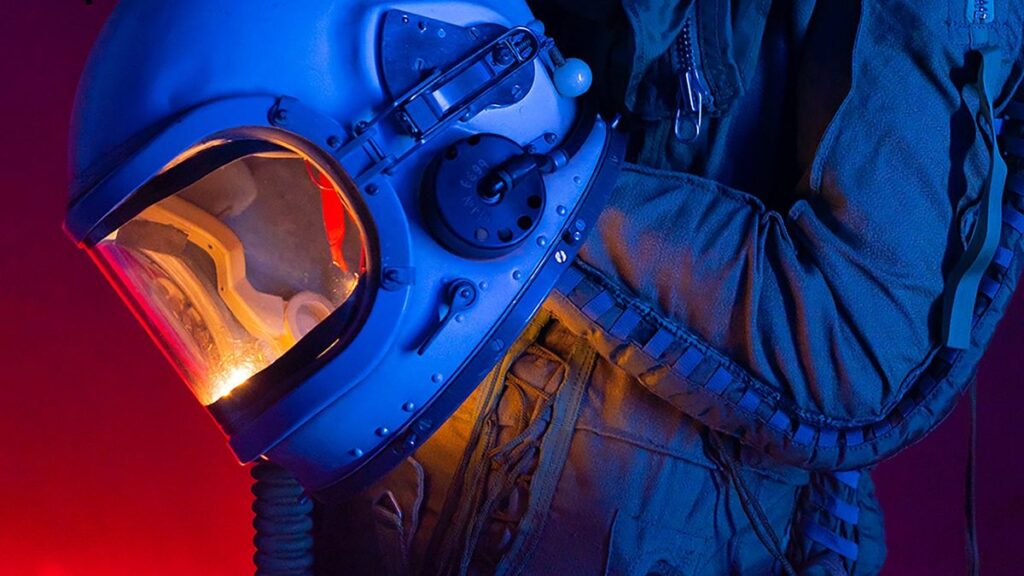
Philip Kaufman’s adaptation of Tom Wolfe’s book about the test pilots and the first American astronauts is one of the strangest big movies ever made in Hollywood, and its strangeness is the reason it endures. It looks like a patriotic epic. It was sold, more or less, as a patriotic epic. It is actually a long, sly, tonally unstable argument about the difference between courage and publicity, told by a director who cannot decide whether he wants to salute or snicker, and who eventually realizes that the honest answer is both.
Two Movies Sharing One Runway
Structurally, the film runs on a split. One track stays in the high desert at Edwards Air Force Base, where pilots push airplanes past what the airplanes are rated to survive, get drunk, and die with a regularity the film treats as weather. The other track follows the seven men selected for the Mercury program, who are processed, photographed, medically humiliated, and turned into a magazine product before any of them leaves the ground.
The desert material is shot like a Western, because it is one. Kaufman gives Chuck Yeager a horse, a landscape, a saloon, and a rival, and the film’s opening act plays out the mythology of the frontier professional almost without irony. Sam Shepard’s performance is the anchor. He underplays to the point of near-inertness, and it works, because the movie needs a figure whose competence does not require narration. Shepard has a face that suggests he is always doing arithmetic he will not show you. Against the noise of everything else in the film, that stillness reads as the real article.
The Mercury track is comedy, and often broad comedy. Politicians bluster, engineers panic, reporters swarm like insects, and the astronauts spend as much time negotiating with bureaucrats over whether their capsule gets a window as they do preparing to sit on top of a rocket. The film is genuinely funny here, and the funniness is load-bearing. Kaufman is arguing that the space program was a public relations campaign that happened to require actual bravery as a raw material, and you cannot make that argument in a reverent register.
The Formal Achievement
What holds the two halves together is craft of a very high order. Caleb Deschanel’s photography treats the desert as a place of hard light and long horizons and treats Cape Canaveral as a place of fluorescent glare and crowded frames. The difference is not decorative. It tells you that one world has room in it and the other does not.
The flight sequences remain a benchmark. Kaufman largely refuses the modern instinct to put you inside the aircraft and shake the camera. Instead he cuts between the pilot’s face, the instruments, and the exterior of a small object in an enormous emptiness, and he lets the sound design do the frightening. Rivets groan. Metal complains. There is a recurring sonic idea in the film where noise builds to a threshold and then falls away into something like silence, and the silence is what makes your stomach drop. Later films with vastly more capable effects have not improved on this, because the effect was never about the effects.
The editing is the other star. This is a very long film that moves, and it moves because Kaufman cuts on ideas rather than on events. He will place a shot of a bureaucratic indignity directly against a shot of an actual risk of death, and the juxtaposition does the work that a lesser film would assign to a speech. The recruitment montage, the press conference, the medical testing sequence: each of these is essentially a comic set piece that also advances a thesis.
The Ensemble
The casting is unusually smart about faces. Ed Harris plays John Glenn as a man of sincere and slightly infuriating rectitude, and the performance is generous enough to let Glenn’s earnestness be both a genuine virtue and a professional advantage. Scott Glenn’s Alan Shepard is spikier, funnier, less likable, and more recognizably human. Dennis Quaid plays Gordon Cooper as pure grin and appetite, a young man who has correctly identified that swagger is now part of the job description. Barbara Hershey, as Yeager’s wife, gets less screen time than she deserves but plays the one character who seems to have thought clearly about what all this costs.
Crucially, the film gives real weight to the wives generally. The scenes of women waiting, of women being managed by the press office, of women watching launches on television, are not filler. They are where the movie’s ambivalence about heroism becomes concrete. Someone is always at home doing the arithmetic that the hero is not showing you.
Where It Falls Short
Here is my reservation, and it is not a small one. The film’s comic mode repeatedly slides into cartoon, and when it does, it undercuts the very argument it is making.
The two recruiters who wander through the film as a bumbling double act are broad in a way that belongs to a different picture. The political figures are caricatures. Worst of all, the treatment of the German-accented rocket engineer is a lazy joke the film keeps returning to as if it were getting funnier. The problem is not that satire is inappropriate; it is that this particular satire is cheap, and cheapness weakens the case. If the institution is genuinely absurd, show its absurdity with the same specificity you give the flying. When Kaufman instead reaches for a cheap accent or a pratfall, he lets the audience off the hook. We stop thinking about how myth is manufactured and just laugh at some idiots.
There is a related structural cost. Because the Yeager material is played straight and the Mercury material is played comic, the film’s sympathies tilt further toward the pilots than its own thesis can quite support. The movie wants to say that the astronauts earned their myth, that they turned a publicity exercise into something genuinely brave. It says this in its last act with real force. But it has spent so long treating them as figures of fun that the elevation feels partly like an argument the film is making to itself. A late sequence intercutting a ceremonial event with a solitary flight is the most beautiful thing in the picture and also the moment where you can most clearly see the seams: two ideas being welded rather than grown together.
Why the Reputation Holds
Because almost nothing else attempts this. The default American film about the space program is inspirational and procedural, and there are good ones. This is the only one that is fundamentally suspicious of its own subject while also being moved by it. It understands that the men who did this were both extraordinary and ridiculous, that the country needed them for reasons that had nothing to do with their character, and that they went anyway.
The film’s best insight, and the one that survives its unevenness, is that “the right stuff” is never defined. Every character gestures at it. Nobody can say what it is. Kaufman keeps that vagueness deliberately, because the vagueness is the point: it is a phrase that lets a culture worship something it cannot name, and therefore cannot examine. That is a sharper idea than most reverent epics get anywhere near.
It is too long, tonally erratic, and about twenty minutes of it is beneath the rest. It is also, at its best, as good as American filmmaking of its era gets, and the last hour earns a payoff a more disciplined version of this material would not have. Recommended, with the warning that you may spend a while wondering what kind of movie you are watching. That confusion is not a flaw in you.
