
Richard Linklater pitched Dazed and Confused as an American Graffiti for the 1970s, and the comparison is useful mainly for showing how far the finished film drifted from it. George Lucas’s picture is organized around a handful of protagonists making decisions about the future on the eve of leaving town. Linklater’s film has almost no decisions in it, and very little future-facing anxiety at all. What it has instead is duration: a single night, the last day of school, tracked across an enormous ensemble with something closer to anthropological patience than plot. That refusal to organize itself around a conventional protagonist is the film’s most radical formal choice, and it is why the film still feels distinct from the countless teen movies that borrowed its soundtrack aesthetic without understanding its structure.
A Film Without a Hero, on Purpose
Mitch Kramer, a nervous incoming freshman surviving a hazing ritual on his last day of junior high, comes closest to functioning as a through-line, and Randall “Pink” Floyd’s quiet resistance to signing a coach’s no-drugs pledge supplies something like a moral spine. But neither character dominates the film’s attention in the way a protagonist ordinarily would. Linklater distributes screen time with something close to democratic evenness across two dozen characters, and the effect is less like watching a story than like being dropped into an entire social ecosystem for one night, with the camera drifting from group to group the way attention actually drifts at a party. That structural choice is a considerable risk, since it denies the audience a single emotional anchor, and the film’s success in making it work anyway is easy to underrate precisely because it looks so effortless.
Music as Structure, Not Decoration
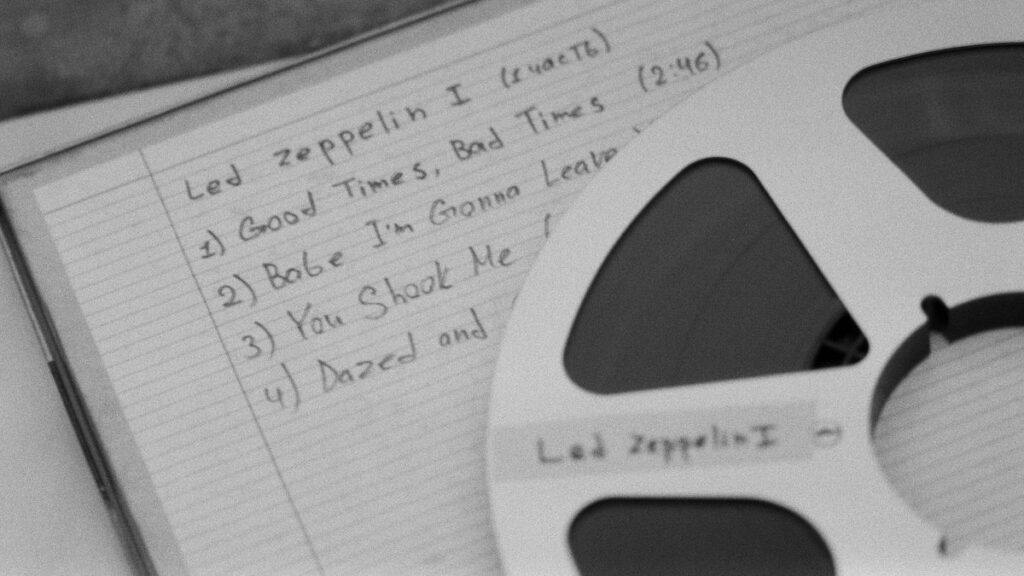
The soundtrack’s reputation, drawn almost entirely from mid-to-late-1970s classic rock, tends to obscure how functionally the music is deployed rather than simply enjoyed. Linklater times cues to specific narrative beats with a precision that period-soundtrack imitators rarely bother to match: the opening song’s drum kick lands on the establishing shot, a school bell rings in sync with a song about summer vacation, and the arrival of the film’s most magnetic supporting character, Wooderson, is scored specifically to cue his outsized presence before he says a word. The music is not selling nostalgia for its own sake, it is doing character work that the sparse plot leaves the songs to carry.
Wooderson and the Danger of a Scene-Stealer
Matthew McConaughey’s Wooderson, a high school graduate still hanging around teenagers years after he should have moved on, could easily have been played as a punchline or a cautionary figure. The film does something more interesting: it lets Wooderson’s confidence and social fluency, moving comfortably between cops, coaches, and teenagers alike, read as genuinely magnetic before quietly letting the audience notice the sadness underneath his stalled trajectory. The film never states the judgment outright, trusting the audience to register the gap between how cool Wooderson appears and how little forward motion his life actually has.
What the Absence of Plot Actually Costs
The film’s loose, hangout structure is also a legitimate limitation. Characters like Darla exist almost entirely as a single note of aggression, and several of the ensemble’s supporting players are given so little to do that their inclusion reads as demographic completeness rather than dramatic necessity. A tighter film might have sacrificed some of that breadth for depth. But breadth is precisely the point Linklater is making: high school is not one story, it is dozens happening simultaneously in the same parking lot, and a film willing to sacrifice individual character depth in service of that panoramic honesty is making a deliberate trade, not an accidental one.
What keeps Dazed and Confused durable, beyond its now-legendary early appearances by a generation of future stars, is that it never mistakes nostalgia for the thing it is actually documenting. It is less interested in celebrating 1976 than in accurately reproducing the specific, aimless, hormonal texture of one unremarkable, enormous night, trusting that the texture itself, rendered honestly, would be enough.
