

Every December the argument comes back around like a fruitcake nobody wants to throw out: is Die Hard a Christmas movie? The question is usually asked as a joke and answered as a joke, which is a shame, because taking it seriously is one of the better ways into what John McTiernan’s film is actually doing. So we will settle it here. But a ruling on the holiday question is worthless if the film underneath it does not hold up, and the more interesting news is that it does, thirty-odd years on, better than most of the movies that spent the following decade imitating it.
Die Hard at a Glance
| Released | July 15, 1988 (United States) |
|---|---|
| Director | John McTiernan |
| Screenplay | Jeb Stuart and Steven E. de Souza |
| Based on | Nothing Lasts Forever (1979), a novel by Roderick Thorp |
| Starring | Bruce Willis, Alan Rickman, Bonnie Bedelia, Alexander Godunov, Reginald VelJohnson |
| Runtime | 132 minutes |
| Rating | R |
| Budget | About $25 to $35 million |
| Box office | Roughly $140 million worldwide |
| Nakatomi Plaza | Played by Fox Plaza in Century City, Los Angeles |
| Oscar nominations | Four: Film Editing, Visual Effects, Sound Effects Editing and Sound |
| National Film Registry | Selected in 2017 |
The Christmas Question, Argued Properly
The lazy case for yes is that it is set on Christmas Eve, there is a party, there is a tree, and Vaughn Monroe sings “Let It Snow” over the end credits. The lazy case for no is that it is a hostage thriller with a body count and the holiday is set dressing. Both arguments are about decoration, and decoration is not what makes a Christmas movie.
What makes a Christmas movie is structural. The genre has a shape: a person is separated from their family by their own pride or their own work, they are put through a night of ordeal, and they are returned to the family changed and humbled. That is A Christmas Carol. It is It’s a Wonderful Life. It is, precisely, Die Hard. John McClane flies to Los Angeles because his marriage is failing over whose career matters more. He blows the reunion within ninety seconds by sneering at his wife’s use of her maiden name. The entire film is then an extended penance for that sneer, and the film knows it: the most emotionally exposed thing McClane does in two hours is not shoot anybody, it is confess, over a radio, to a stranger, that he was too proud and too stupid to say he was sorry.
So the verdict is yes, and not on a technicality. Die Hard is a Christmas movie in the same load-bearing sense that Dickens is, because the holiday is what supplies the film’s moral clock. Everyone in that building is where they are because of a party they were obliged to attend. The villains’ plan depends on the date. The hero’s humiliation depends on the date. Take Christmas out and you do not have the same film with different wallpaper, you have no reason for any of these people to be in the room. That is the test, and it passes it.
One honest concession to the other side: the film is not about Christmas in the way it is about class resentment, marital pride, and institutional incompetence. It is a Christmas movie the way Jaws is a Fourth of July movie. The holiday is the frame and the pressure, not the subject. Anyone who says the yuletide content is thin is not wrong about the content. They are wrong about which part of a film does the work.
A Machine Built Out of Geography
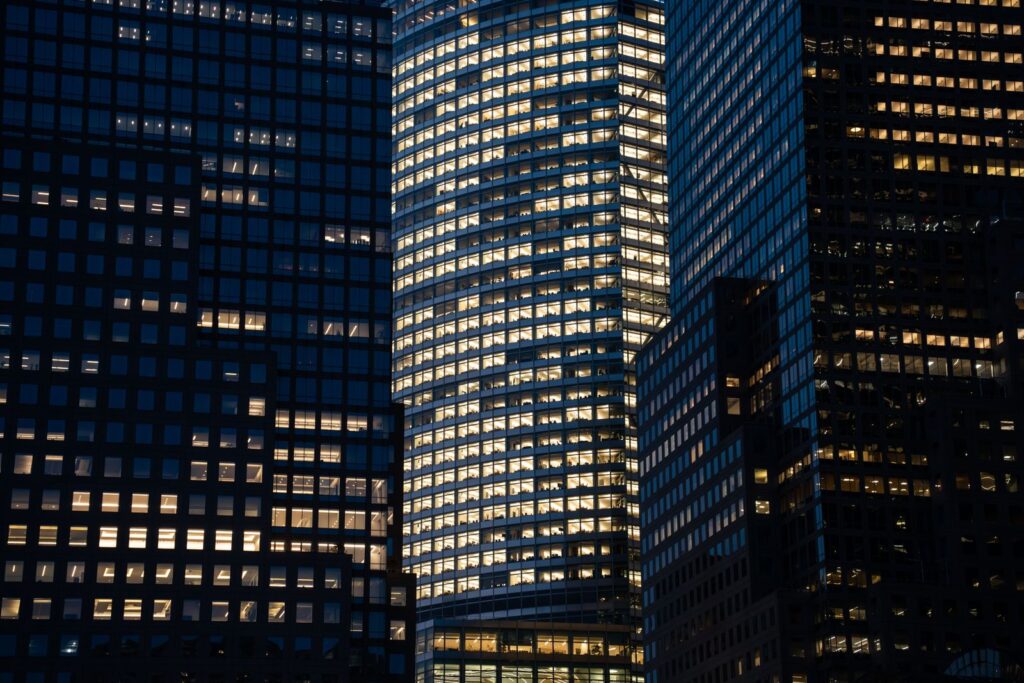
Now the film as an action picture, which is where it earns its reputation. The single most impressive thing about Die Hard is that you always know where you are. McTiernan and cinematographer Jan de Bont establish Nakatomi Plaza as a legible vertical map in the first twenty minutes, and then every subsequent beat is an argument about that map. The elevator shafts, the air ducts, the unfinished floors, the roof, the parking level, the fire hose: each is introduced before it is needed, and each is used exactly once. The film is a closed system, and its tension comes from watching a man with no shoes convert architecture into weapons faster than the people with the blueprints can adapt.
This is not a small craft point, it is the whole difference between this film and its descendants. Most modern action cinema generates excitement through cutting rate and volume. Die Hard generates it through information. McTiernan holds shots long enough for you to see the space, cuts to show consequence rather than to manufacture energy, and trusts that a wide shot of a man deciding to do something insane is more frightening than fifteen close-ups of him doing it. Michael Kamen’s score, which keeps sliding into Beethoven’s Ninth in the villains’ key, does something similar: it treats the antagonists as the ones with the symphony and the hero as the one with the improvised percussion.
The other structural trick is that McClane is never given the initiative for long. He wins a room, loses the building, wins a floor, loses his position. The film is a sequence of small local victories inside a widening strategic disaster, which is why it stays tense in a way that films with escalating set pieces do not. Escalation is predictable. Attrition is not.
Willis, Rickman, and the Comedy of Scale
Bruce Willis was a television comic actor when this was cast, and that choice is the film’s second-best decision. He is not built like a movie action hero, he complains constantly, and his jokes are aimed mostly at himself. The performance works because Willis plays fear as irritation. He is not brave, he is annoyed, and annoyance keeps a man moving when courage would have stopped to think.
Opposite him, Alan Rickman gives the performance that defined a generation of screen villains and, unfortunately, licensed a thousand worse imitations. What people remember is the drawl. What matters is that Rickman plays Hans Gruber as a man of genuine competence who is faintly bored by the gap between his intellect and everyone else’s, and who is undone not by heroism but by the one thing his class contempt made invisible to him. Every good beat between the two men is a class joke: the fluent cosmopolitan thief cannot conceive of the blue-collar cop as an actor in his own story.
The supporting bench is better than it needs to be. Bonnie Bedelia refuses to play the wife as a hostage-shaped object, and her scenes with Rickman are among the film’s coldest and best. Reginald VelJohnson has the harder job of humanizing an entire radio channel, and does it. Alexander Godunov, as the henchman with a personal grievance, supplies the animal menace that Rickman deliberately withholds.
Where It Does Not Hold
Here is our real complaint, and it is not a small one. Die Hard has a contempt problem. The film needs everyone outside the tower to be an idiot, so it makes them idiots, and it makes them idiots in bad faith. The deputy police chief is written as a braying fool with no plausible interior life. The FBI agents are cartoons. The television reporter is a wolfish caricature whose late-film behavior exists purely so the audience can enjoy his comeuppance. These are not characters, they are punching bags, and the film keeps stopping its own momentum to set them up and knock them down.
It matters because the film’s central idea, that institutions fail and individuals improvise, is a real idea that would land harder if the institutions were competent and still lost. Compare the way the film treats Powell, the one uniformed officer allowed to be a person: those scenes have weight precisely because he is not a fool. Every scene of the chief being wrong is a scene where the movie is flattering us instead of pressuring us. There is also a stretch in the middle third, once the authorities have arrived and the film starts cross-cutting to the street, where the pacing goes slack and the tower plot has to wait for the ground plot to catch up.
None of that sinks it. It does mean the film is a little dumber than its craft, and it is why its imitators found the formula so easy to strip for parts. They copied the contempt, which is free, and not the geography, which is expensive.
The Verdict
Die Hard is the best American action film of its decade and one of the few genre pictures whose reputation is entirely deserved rather than inherited. It is also, on the evidence of its own structure, a Christmas movie, and the people who insist otherwise are grading it on tinsel. Watch it in December. Watch it in July. Just watch the wide shots, and notice how rarely anyone bothers with them anymore.
Die Hard: Questions Readers Ask
Is Die Hard a Christmas movie?
Yes. As argued above, the case rests on structure rather than decoration: a man estranged from his family by pride goes through a night of ordeal on Christmas Eve and is returned to them humbled. The holiday supplies the party that puts everyone in the building, the date that the villains’ plan depends on, and the moral clock of the story. Take Christmas out and the film loses its reason to exist, which is the real test of whether a holiday matters to a movie.
Why is Die Hard rated R?
Mainly for its violence and its language. The gunfights are bloody by the standards of the late 1980s, several deaths are shown graphically, and McClane swears his way through the entire night. There is also brief nudity in the office party scenes. It is not a film for young children, though many families now treat it as a teenage rite of passage in December.
What is Die Hard based on?
The film adapts Roderick Thorp’s 1979 novel Nothing Lasts Forever, itself a sequel to his earlier book The Detective. The screenplay by Jeb Stuart and Steven E. de Souza keeps the core premise of a lone cop trapped in a skyscraper seized by armed men, but lightens the hero, sharpens the villain and adds the marital story that gives the film its heart.
Where was Die Hard filmed?
Nakatomi Plaza is Fox Plaza in Century City, Los Angeles, which was still new when the film was made. Using a real tower is one reason the geography works so well: the unfinished floors, the elevator shafts and the roof all feel like parts of an actual building rather than a set.
How long is Die Hard?
The film runs 132 minutes. That is long for an action picture of its era, and yet it rarely feels it, because the story plays out in something close to real time across a single night.
Did Die Hard win any Oscars?
No, but it earned four nominations, all in technical categories: Film Editing, Visual Effects, Sound Effects Editing and Sound. Its longer lasting honor came in 2017, when the Library of Congress selected it for preservation in the National Film Registry as culturally, historically or aesthetically significant.
Is Die Hard still worth watching today?
Absolutely, and not only as nostalgia. The film’s clarity of space, its patient build and the double act between Willis and Rickman hold up better than most of what followed it. If you have only seen it in fragments on television, watch it properly, start to finish, with the lights down. It plays as a tighter, smarter film than its reputation as a blockbuster suggests.
